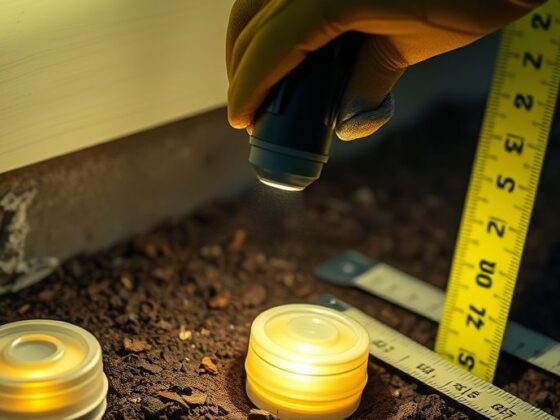
Termite risk is not uniform. A wood-frame home on a concrete slab in Phoenix faces different species, moisture drivers, and treatment options than a pier-and-beam house in Charleston or a stucco ranch in San Diego. Regional climate shapes which termites establish colonies near your foundation, when swarmers emerge, how quickly damage progresses, and which treatment methods work reliably. Soil composition affects chemical barrier performance and the likelihood of subterranean tunnel networks reaching your structure. Local building codes—crawlspace ventilation requirements, vapor-barrier standards, foundation design—create or reduce termite entry points before the first board is nailed.
You can use the Termite Infestation Map to see which species are documented in your county, then cross-reference seasonal swarming windows and moisture conditions that increase risk. Observable signs include mud tubes along foundation walls, discarded swarmer wings near windowsills or door frames, hollow-sounding wood when tapped, and small piles of pellet-shaped frass below exit holes in drywood infestations. These indicators confirm that termites have reached your structure, but absence of visible signs does not mean absence of termites. Subterranean workers tunnel through soil and wall voids without surface evidence until damage becomes advanced.
A professional termite inspection adds moisture mapping, probing of susceptible wood members, species identification, and assessment of conducive conditions—landscape grading, wood-to-soil contact, plumbing leaks, clogged gutters—that you may not recognize as risk factors. The inspector’s report documents active infestation, prior damage, and treatment recommendations calibrated to your home’s construction and the species present. You cannot perform this assessment with a flashlight and a screwdriver; the liability, access limits, and diagnostic accuracy require a licensed professional. What you can do is understand which species live in your region, what they look like, where they enter structures, and when to schedule an inspection based on local swarming seasons and real-estate transaction timelines.
Core Variables That Change Your Local Termite Risk
Termite risk is not uniform across neighborhoods, and generic national advice often misses the factors that matter most in your specific situation. Five variables consistently change how homeowners should think about inspection timing, treatment decisions, and real-estate negotiations: the dominant termite species in your area, soil moisture patterns around your foundation, structural access points, your home’s construction type, and local treatment history or pressure from nearby infestations.
Species drives everything else. Subterranean termites—the most common group across the continental United States—require soil contact and moisture to survive, which means risk concentrates around foundations, crawlspaces, and anywhere wood touches earth. Eastern subterranean termites dominate from the Atlantic coast through the Midwest, while Formosan subterranean termites create larger colonies and faster damage in Gulf Coast states and Hawaii. Drywood termites operate differently: they infest wood directly, need no soil contact, and leave piles of fecal pellets as the primary evidence. Drywood activity is heaviest in coastal California, southern Florida, and parts of the Southwest. Dampwood termites require high moisture and decaying wood, so they appear mainly in the Pacific Northwest and northern California where humidity and wood rot overlap. You can explore species distribution patterns using the Termite Infestation Map, but a local pest-control professional will confirm which species are active in your immediate area.
Moisture is the second variable. Subterranean termites follow moisture gradients, so homes with poor drainage, leaking gutters, irrigation systems near the foundation, or crawlspaces with standing water face higher risk regardless of neighborhood averages. A home on a hillside with good drainage may have lower risk than a home two blocks away in a low spot, even if both are in a high-activity county. Moisture also accelerates wood decay, which attracts both subterranean and dampwood species and makes structural damage progress faster once an infestation begins.
Access points change how easily termites reach your structure. Subterranean termites build mud tubes over concrete, but they move faster through cracks in slab foundations, gaps around plumbing penetrations, and untreated wood in contact with soil. Homes with crawlspaces offer more access points than slab foundations, and older homes with stone or brick foundations often have more gaps than poured-concrete construction. Drywood termites enter through attic vents, eaves, and any exposed wood, so access is less about the foundation and more about the building envelope.
Foundation type and construction age also matter. Slab-on-grade homes in termite-active areas are often pre-treated during construction under current building codes, but that treatment degrades over time—typically 5 to 10 years depending on the product used and soil conditions. Homes built before the 1990s in many states had no pre-treatment requirement. Pier-and-beam or crawlspace foundations allow easier inspection and treatment access but also create more opportunities for termite entry if ventilation, vapor barriers, or wood clearances are inadequate.
Local pressure—the concentration of active infestations in nearby properties—is harder to measure but often visible in treatment records and inspection reports during real-estate transactions. If several homes on your block have been treated in the past three years, the probability of foraging termites encountering your property increases. County-level risk maps are useful for general context, but block-level patterns matter more for individual decision-making. Robert Trawick, a licensed inspector and TermiteHQ contributor, notes that treatment history in adjacent properties often signals soil conditions or construction patterns that affect the entire neighborhood, not just isolated homes.
These variables interact. A home with a treated slab foundation in a low-moisture area may need only periodic inspections, while a pier-and-beam home with poor drainage in a Formosan termite zone may justify both a soil treatment and an annual monitoring contract. Understanding which variables apply to your property helps you move past generic advice and ask the right questions when you schedule a termite inspection.
How Local Termite Risk Factors Shape Your Property Exposure
Termite risk is not uniform. The species active in your area, soil composition, seasonal moisture patterns, foundation type, and local construction practices combine to create distinct exposure profiles that vary by region, county, and sometimes neighborhood. Understanding these variables helps you interpret inspection findings, set realistic monitoring intervals, and recognize when professional evaluation is warranted.
The United States is divided into termite infestation probability zones mapped by the U.S. Department of Agriculture Forest Service and referenced in the International Residential Code. These zones—ranging from none to very heavy—reflect the likelihood of economically significant damage based on climate, native species distribution, and historical infestation data. Subterranean termites dominate most of the continental U.S., with Eastern subterranean termites (Reticulitermes flavipes) prevalent from the Atlantic coast through the Midwest, and Western subterranean termites (Reticulitermes hesperus) common in California and the Pacific Northwest. Formosan subterranean termites (Coptotermes formosanus), a more aggressive species, are established in coastal areas of the Southeast, particularly Louisiana, Mississippi, Alabama, Georgia, South Carolina, and parts of Texas and Florida. Drywood termites (Incisitermes and Cryptotermes species) are largely confined to coastal California, southern Florida, and Gulf Coast states, where they infest wood directly without soil contact.
Climate drives both species range and activity intensity. Subterranean termites require consistent soil moisture and moderate temperatures; colonies slow or suspend foraging when soil temperatures drop below 50°F or rise above 95°F. In northern states, swarming typically occurs in spring—March through May—while Gulf Coast and southeastern regions may see multiple swarm events from February through early summer. Drywood termites, which do not depend on soil moisture, remain active year-round in warm climates but are limited by freezing winter temperatures. Knowing your local swarm season helps you distinguish reproductive flights from active infestations and time inspections appropriately.
Foundation type and construction era significantly affect vulnerability. Slab-on-grade foundations, common in the South and Southwest since the 1960s, offer fewer visible access points but can conceal subterranean termite entry through expansion joints, utility penetrations, and cracks in the slab. Crawl spaces and basements, more common in the Midwest, Northeast, and older housing stock, provide visible inspection access but also create moisture-prone environments that attract termites if ventilation, grading, or vapor barriers are inadequate. Pier-and-beam foundations in Texas and parts of the South allow direct wood-to-soil contact if piers settle or wooden components touch grade. Post-tension slab foundations in Arizona, Nevada, and parts of California require careful treatment planning due to embedded cables.
Soil composition influences both termite behavior and treatment options. Sandy, well-drained soils in coastal and desert regions allow easier tunneling and faster colony expansion but also permit better liquid termiticide distribution. Clay-heavy soils in the Midwest and parts of the South retain moisture longer, sustaining termite activity during dry periods, but can channel or pool liquid treatments unpredictably. Regions with caliche layers—hardpan calcium carbonate common in the Southwest—may require modified treatment techniques or increased monitoring, as subterranean termites exploit natural fissures and utility trenches.
Local moisture patterns—annual rainfall, humidity, seasonal flooding, and irrigation practices—directly affect termite pressure. The Southeast, with high humidity and frequent summer storms, sustains year-round subterranean termite activity and accelerates wood decay that attracts both subterranean and drywood species. Arid regions like Arizona and Nevada see concentrated termite activity near irrigation systems, air-conditioner condensate lines, and landscape watering zones. Pacific Northwest properties face elevated risk from persistent winter moisture and poor crawl-space ventilation, even though colder temperatures slow colony growth compared to southern states.
State and local licensing requirements shape the professional landscape. Most states require pest-control operators to hold specific structural pest control or wood-destroying insect licenses, with additional certifications for fumigation or certain restricted-use pesticides. California maintains separate categories for termite work under the Structural Pest Control Board. Florida requires Wood-Destroying Organism Inspection Reports (WDOIR) for real-estate transactions, while other states have no mandated inspection trigger. Knowing your state’s licensing structure and inspection standards helps you verify credentials and understand what a local report will—and will not—cover. For inspection context and report interpretation, see our termite inspection guide.
Regional construction codes also vary. The International Residential Code mandates specific termite protection measures in moderate to heavy infestation zones, including soil treatment, physical barriers, or naturally durable wood
What You Can Do Before Calling a Professional
You cannot diagnose termite activity from a distance, and you should not apply pesticides without a license, but you can document what you see, organize your property records, and prepare questions that help a licensed inspector work efficiently. This preparation saves time during the inspection appointment and gives you a clearer picture of what to ask about treatment options if the inspector finds active termites.
Start by walking the accessible perimeter of your home with a flashlight and a smartphone camera. Look for mud tubes on foundation walls, sill plates, piers, and inside crawlspaces or basements. Subterranean termites build these tubes—roughly the diameter of a pencil or wider—to travel between soil and wood while maintaining humidity. Photograph any tubes you find, and note their location relative to doors, utility penetrations, or corners. Do not break the tubes open; an inspector will want to see them intact to assess whether they contain live workers.
Check window sills, door frames, and any wood trim that contacts soil or sits near grade level. Tap the wood gently with a screwdriver handle. Termite-damaged wood often sounds hollow and may feel soft or crumble under light pressure. If you see small piles of frass—pellets that resemble sand or sawdust—near wooden furniture, window frames, or attic beams, photograph the pile and the wood above it. Drywood termites expel frass through kick-out holes, and the color and shape of the pellets help inspectors distinguish drywood activity from other wood-boring insects. You can learn more about visual clues on the signs of infestation page.
Gather any termite inspection reports from previous owners, pre-purchase inspections, or past treatments. If you have a termite bond or warranty, locate the contract and note the treatment date, the company name, and whether the bond includes re-treatment or damage repair. Inspectors often ask whether the home has been treated before, what method was used, and how long ago, because prior treatments affect where they look and what follow-up options make sense.
Make a short list of questions based on what you found. If you saw mud tubes, ask the inspector whether they appear active and where the colony is likely entering. If you found frass, ask whether the inspector can confirm drywood termites and whether localized treatment is an option. If your neighbor recently treated for termites, ask whether your home shares risk factors—such as shared landscaping, wood-to-soil contact, or similar construction—and whether a preventive inspection is warranted. The termite inspection guide explains what licensed inspectors check and how they document findings.
Understand the boundaries of what you can safely observe. You should not enter tight crawlspaces without proper ventilation, lighting, and someone who knows you are there. You should not remove wall sections, drill into wood, or open sealed areas to look for termites; those actions can spread activity, create moisture problems, or violate structural code if done incorrectly. You should not apply over-the-counter termiticides to soil, wood, or foundation walls. Pesticide labels carry legal force, and misapplication can contaminate soil, drive termites deeper into hidden areas, or create gaps in a future professional treatment. If you are preparing for a real-estate transaction, Robert Trawick notes that incomplete or DIY treatments often complicate closing because lenders and title companies require licensed documentation.
Once you have photos, notes, and records in hand, contact a licensed termite inspector in your area. Explain what you observed, share the photos if the company accepts them by email, and ask whether they recommend an interior and exterior inspection or a more focused look based on your findings. The inspector will use moisture meters, sounding tools, and sometimes borescopes or infrared cameras to assess areas you cannot safely reach. After the inspection, you will receive a written report that identifies any active infestations, describes the species, estimates the extent of activity, and outlines treatment options. That report becomes the foundation for comparing bids, understanding costs, and deciding whether to treat immediately or monitor over time. You can explore treatment methods and their trade-offs on the treatment and prevention page.
When Licensed Professional Judgment Changes the Outcome
Most homeowners can identify visible termite damage, mud tubes on foundation walls, or discarded wings near windowsills. The harder question is what those signs mean for structural safety, treatment scope, and whether a transaction should proceed. A single mud tube on an exterior stem wall usually indicates exploratory foraging. The same tube running through a crawlspace sill plate and into floor joists suggests active colony feeding and possible hidden damage behind drywall. Licensed inspectors distinguish between these scenarios using moisture meters, sounding tools, and species behavior patterns that aren’t visible in photos or described in checklists.
Professional judgment matters most when damage is concealed, species identification is uncertain, or treatment timing affects a real-estate closing. Subterranean termites in the Southeast often enter through expansion joints in slab foundations, then travel horizontally inside wall voids before any interior evidence appears. An inspector trained in regional construction methods knows where to probe, which walls to open for verification, and when to recommend a moisture intrusion assessment before treatment. Drywood termites on the West Coast leave fecal pellets below kick-out holes, but pellet color, shape, and volume indicate whether the infestation is new, mature, or already treated by a previous owner. That distinction changes whether spot treatment is sufficient or whole-structure fumigation is warranted.
Robert Trawick, a licensed inspector and TermiteHQ contributor, reviews cases where report language directly affects buyer negotiations and lender requirements. A report that lists “evidence of previous termite activity” without clarifying whether damage was repaired, treatment was completed, or re-infestation occurred can stall a closing or trigger unnecessary re-treatment. Trawick’s review process confirms that language matches observable conditions, that recommendations are proportional to infestation severity, and that any structural repairs are documented with contractor invoices and building permits. Buyers relying on generic checklists or unlicensed “pest advisors” often misinterpret old mud tubes as active infestations or assume that borate-treated wood eliminates all future risk.
High-stakes decision points include slab-foundation homes with interior damage but no exterior evidence, properties with previous liquid termiticide applications that may have failed, and structures where wood-to-soil contact or chronic moisture creates continuous re-infestation pressure. In these situations, a licensed professional determines whether a standard perimeter treatment will reach the colony, whether soil trenching is required under concrete patios, and whether ongoing monitoring is more appropriate than immediate full treatment. Homeowners who attempt to interpret infestation signs without understanding local soil types, construction practices, and species-specific behavior often overestimate or underestimate risk by several years.
Professional routing is also necessary when treatment costs exceed initial estimates due to inaccessible crawlspaces, when a seller’s pre-listing report conflicts with a buyer’s inspection, or when a property manager must decide whether to treat individual units or an entire multi-family building. These decisions depend on liability exposure, warranty terms, and whether state regulations require licensed applicator oversight for certain termiticide products. The TermiteHQ expert team provides context for these scenarios but does not replace the site-specific assessment that only a local inspector can deliver after physically examining the structure, reviewing construction documents, and testing soil conditions around the foundation.
Tools, Sources, and Common Questions
The Termite Infestation Map shows county-level termite pressure zones across the United States, drawn from USDA Forest Service climate data, university extension records, and state agriculture department pest reports. The map identifies areas where subterranean termites are most active, where drywood species are established, and where Formosan colonies have been documented. It does not predict whether your specific property will develop an infestation, but it clarifies whether your region requires annual monitoring, whether soil treatments are standard practice, and whether real-estate transactions typically include termite inspection contingencies.
Regional termite risk depends on soil moisture, wood-to-ground contact, construction type, and local species presence. A home in coastal South Carolina faces different pressure than a property in northern Idaho, even though both states report termite activity. The Termite Risk Score tool combines your ZIP code, construction details, and observable conditions to estimate relative risk and suggest inspection timing. The Treatment Cost Estimator provides regional cost ranges for liquid barriers, bait systems, and localized treatments based on square footage and foundation type.
TermiteHQ draws local termite data from university Cooperative Extension offices, state pest-control licensing boards, USDA Agricultural Research Service publications, and the National Pest Management Association’s regional activity reports. We do not collect or publish infestation reports from individual properties. Our Source Methodology page explains how we evaluate extension bulletins, peer-reviewed entomology studies, and product-label language, and how we route readers to licensed professionals when site-specific decisions are required. Robert Trawick reviews content that involves inspection reports, real-estate contingencies, and treatment-method comparison, ensuring that editorial guidance reflects field conditions rather than manufacturer claims.
TermiteHQ is an educational resource. We do not perform inspections, sell treatments, refer contractors, or guarantee outcomes. Local termite risk changes with weather patterns, landscaping decisions, and nearby construction activity. A professional inspection remains the only reliable way to confirm active termites, assess structural damage, and design a treatment plan that meets your state’s pesticide-use regulations and your lender’s requirements.
Frequently Asked Questions
How do I know if my area has high termite risk?
Check the Termite Infestation Map for your county, then contact your state Cooperative Extension office for recent activity reports. High-risk zones typically include the Southeast, Gulf Coast, Southern California, and Hawaii, where subterranean termites are active year-round. Moderate-risk areas may see seasonal swarms in spring and summer. Your local pest-control licensing board can confirm whether termite inspections are standard practice during real-estate transactions.
Does a termite-free inspection report mean my home is permanently protected?
No. An inspection confirms that the inspector found no visible evidence of active termites or damage on the day of the visit. Termites can enter through soil cracks, utility penetrations, or wood-to-ground contact points that develop after the inspection. Annual monitoring or a renewable treatment contract provides ongoing protection, but no method eliminates future risk entirely.
Are termite treatments required by law in high-risk areas?
No state requires homeowners to treat for termites unless a lender, insurance policy, or local housing code mandates it. Some mortgage underwriters require a termite inspection and clearance letter before closing. If active termites are found, the purchase contract may require treatment and a follow-up inspection. Review your loan documents and consult a local real-estate attorney if treatment becomes a closing condition.
Can I use online risk maps to skip a professional inspection?
No. Risk maps show regional termite pressure, not the presence or absence of termites in your walls, crawl space, or foundation. Only a licensed inspector can identify live termites, mud tubes, damaged wood, and conducive conditions that require correction. Use risk maps to decide whether annual inspections are justified, not whether you need one at all.
What should I do if my neighbor’s home has termites?
Schedule an inspection. Subterranean termites forage across multiple properties, and colonies can extend hundreds of feet from the nest. Your home may already have termite activity, or it may be at elevated risk if shared landscaping, mulch beds, or wood debris provide continuous pathways. A professional can assess your foundation, install monitoring stations, or recommend a preventive soil treatment if conditions warrant it.